Link to Home Page  |
||
|
The first international computer tournament
was held in Stockholm in 1974, where the world's strongest Chess
programs competed in the first World Computer
Chess Championship. The first title went to the Soviet Union
with a program called Kaissa, spurring the
West to come back with Chess 4.6 the next
year, the start of a 5 year reign by the USA.
|
||
|
Since then we have seen many more such events,
including the widely publicised contest in 1997 between the supercomputer
Deep Blue and the world's strongest player
at the time, Kasparov. Other competitions
have appeared with the games Go (Weichi
from China), Shogi (Japanese Chess) and
Bridge hosting the biggest events.
|
||
|
Recent competitions:
|
||

 Shogi Shogi |
 Go Go |
 Bridge Bridge |
 Chess Chess |
 |
||
The
Contribution to Engine Development |
||
These events are important in
many ways. First they provide an opportunity to test your program. These
are also good opportunities to meet and discuss ideas with competing teams.
These events are often linked to academic conferences, so the evenings become
brainstorming sessions for new ideas. Finally, success in these world championships
has an important commercial impact: It is much easier to sell a program
that is the current World Champion, or in the top few competing programs,
than a program that has not performed well. This generally results in most
teams putting huge amounts of effort preparing for these events. You can
be sure that everyone you face has been burning the midnight oil tuning
their program! |
 |
|
|
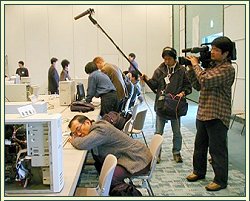
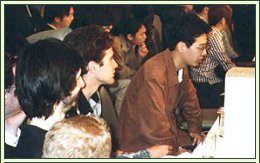
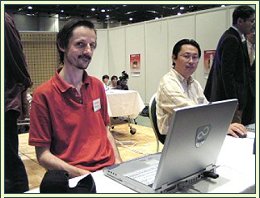
Our in-house Shogi program "Shotest",
authored by Jeff Rollason, competed for
the first time in the 1997 World Computer Shogi Championships in
Tokyo (http://www.computer-shogi.org/index_e.html).
This is a field completely dominated by Japan, now attracting some
60 competing programs. Shotest made some waves, coming 13th at its
first attempt, 10 places higher than any other non-Japanese program.
These early competitions were held in Tokyo bay, close to the huge
Tokyo Disneyland complex.
|
 |
|
 |
The following year really attracted attention
as Shotest qualified for the final round of the top 8-programs:
the first Western program to do so. When the final round came, the
final game between Shotest and IS Shogi would decide who took the
title. Since Shotest had already beaten IS Shogi earlier, having
a non-Japanese World Champion was a strong possibility! Shotest
unfortunately lost, coming 3rd overall, a position it defended the
following year. Shotest has competed in all World Championships
since, excepting 2003 and 2004, where the creation and consolidation
of AI Factory took precedence!
|
|
|
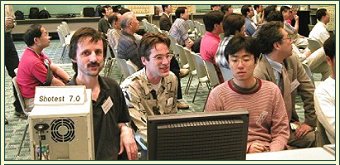
Shotest has achieved the strongest ranking of any Western entry in all championships. It has competed in 10 World Championships, 2 Invitation ISF tournaments (Tokyo) and 3 Olympiads, winning one of the latter. In all it has beaten 3 different world champions on 6 occasions in the year they were world champion. It is available on Xbox, PC and PSP. Work will continue on Shotest.
|
 |
|
Below are links to reports on Computer Shogi
tournaments which include news on AI Factory's Shotest Shogi:
|
||
|
Account of 8th
World Computer Shogi Championship (in Japanese but options to display in English)
- Shotest came third in this competition.
|
||
|
The Computer Shogi Tournaments - Reports by Reijer Grimbergen
|
||
|
The record of the Computer Olympiads can be found here: Including Shotest's Gold at the 2001 Olympiad at Maastricht
|
||
|
Full records of all the results for the Computer Shogi World Championships can be found here: CSA World Computer Shogi Championships
|
|
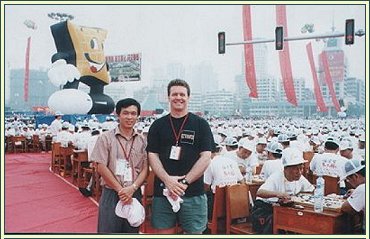
Go++ is now ranked the overall strongest Go
program, from the last few tournaments, and iscurrently the top
selling Go program in Japan. His arch-rival for many years has not
been from Japan, but from China, where the venerable Chen Zhixing,
author of Handtalk (now called Goemate) dominated the early tournaments,
but who has now dropped below Go++ in the rankings.
|
||
Mick's program has featured in many publications,
including a long article in New Scientist: See New Scientist vol 174 issue
2338 - 13 April 2002, page 38 |
|
Chess accounts for the bulk of Computer tournaments and attracts the most substantial effort. The top programs now play at a level substantially above human World Champions, the current strongest being Hydra. One of our old Chess engines is based on the Chess System Tal program, authored by Chris Whittington. This unusual program is renowned for its strong human style, resembling that of the former World Champion Mikhail Tal. Its strength was in the creation of positions with great tactical complexities, as the World Champion Petrosian remarked "I know what to do in the positions that Tal creates, but I do not know how to create them". However AI Factory also has its own newer in-house chess program "Treebeard", authored by Jeff Rollason. This was chosen by Microsoft for their MSN Chess and a later version of this is by far the most popular chess program on Android, ranking #10/#19 UK/US among Brain & Puzzle apps, where the next highest chess is ranked is #45/#81. Treebeard also has an unusual human-like play style through its unusual static lookahead and probability-based tree search. This gives a strong human-like quality to the games, making it an agreeable opponent. However the engine is no slouch as is widely praised for its strength.
|
|
|